
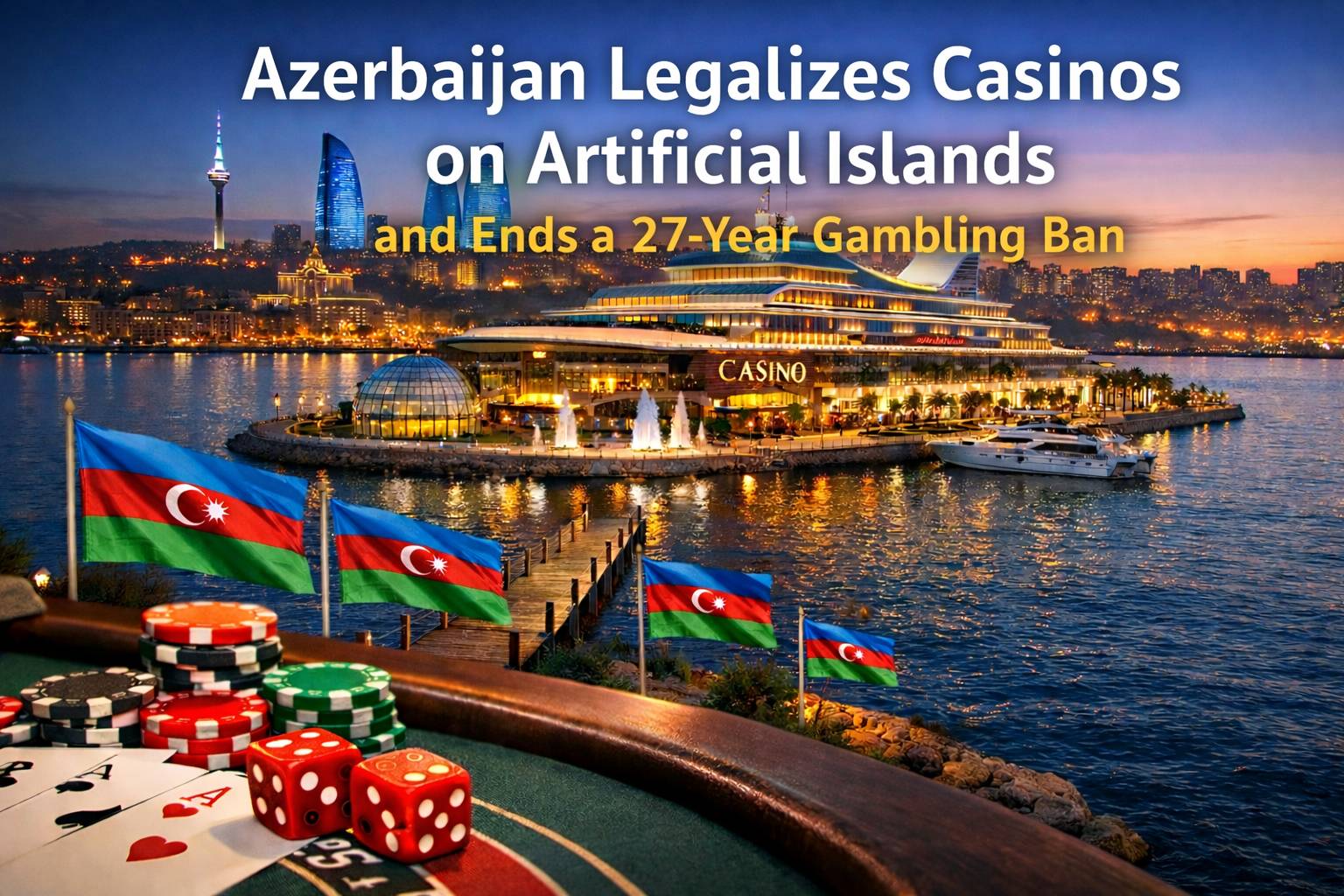
In 2025, Azerbaijan made a decisive shift in its gambling policy by ending a nationwide casino ban that had been in place since 1998. The new law allows casino operations under strict conditions, limiting them exclusively to artificial islands in the Caspian Sea. Gambling remains illegal across mainland Azerbaijan, preserving long standing social and religious boundaries.
The reform is designed to support tourism growth and retain gambling related spending that has historically flowed out of the country, mainly to neighboring casino markets. Licensing requirements, high entry costs for operators, and age restrictions signal a controlled and selective approach rather than broad market opening.
For Azeri players, the change introduces legal casino access inside the country for the first time in nearly three decades, but only within isolated resort zones. Online casinos and land based venues on the mainland remain prohibited, making this reform a targeted exception rather than a full gambling liberalization.

Content Director
декември 22, 2025
Updated

In 1998, Azerbaijan implemented a nationwide ban on casinos and most forms of gambling. The decision followed growing concern over social and economic harm linked to unregulated gambling activity. Authorities positioned the ban as a protective measure, designed to reduce financial instability, gambling addiction, and associated criminal behavior.
As a result, all land based casinos, gaming halls, and private gambling venues were closed. The policy applied uniformly across the country, with no regional exceptions. Gambling was removed from public entertainment spaces and commercial venues, marking a clear shift toward strict state control over betting activity.
For more than two decades, the ban shaped Azerbaijan’s gambling landscape. Compared to neighboring countries that legalized and expanded casino tourism, Azerbaijan maintained one of the region’s most restrictive approaches. Limited state controlled betting formats remained available, but full scale casino gaming was excluded from the legal system.
Despite the ban, player demand did not disappear. Many Azeri players traveled abroad to access casinos, particularly in nearby markets with established gambling industries. This outward flow of casino activity became a persistent pattern, contributing to lost tourism spending and reduced economic participation inside Azerbaijan.
────────── ◈ ──────────
In 2025, Azerbaijan’s parliament approved a legal amendment that marked the first official rollback of the casino ban introduced in 1998. This decision did not reopen the country to general gambling activity. Instead, it created a narrowly defined exception within an otherwise unchanged prohibition framework.
The amendment represents a controlled policy correction rather than a broad reform. Casino gaming re enters the legal system in a limited form, shaped by strict location rules and licensing conditions. The original ban remains largely intact in both scope and intent.
────────── ◈ ──────────
The legal shift is built around geography. Casino operations are permitted only on artificial islands constructed in the Caspian Sea. No part of mainland Azerbaijan is included in the reform. This distinction forms the core of the new framework.
By anchoring casino activity offshore, the state retains physical and regulatory separation between gambling and daily life. The law does not allow gradual expansion into cities or regions. Casino access requires deliberate travel to designated resort zones rather than casual entry.
────────── ◈ ──────────
The artificial island requirement serves multiple purposes. It limits visibility, controls access, and simplifies enforcement. Casino activity becomes contained within purpose built developments rather than dispersed across existing infrastructure.
This structure allows authorities to monitor operations more closely and prevent unregulated spread. It also positions casinos as destination attractions linked to tourism rather than local entertainment options.
────────── ◈ ──────────
The legal amendment reflects economic priorities rather than cultural change. For years, Azerbaijani players have spent casino related funds abroad, particularly in neighboring countries with established gambling markets. The state has openly acknowledged this outbound flow of capital.
By allowing casinos under strict conditions, Azerbaijan aims to retain part of this spending while attracting foreign visitors. The reform targets high value tourism and controlled investment rather than domestic gambling expansion.
────────── ◈ ──────────
Social concerns remain central to the reform. The government has repeatedly emphasized that gambling will not enter cities, residential areas, or public entertainment spaces. Mainland restrictions remain fully enforced.
This balance between economic opportunity and social limitation defines the 2025 shift. Casino legalization exists as an exception, not a replacement, for Azerbaijan’s long standing gambling policy.
Azerbaijan’s casino legalization framework is built around geographic isolation. The law does not introduce casinos into everyday public space. Instead, it limits gambling to a single, clearly defined environment designed to separate casino activity from residential life, cities, and social infrastructure.
This approach allows the government to support tourism driven casino projects while maintaining strict control over visibility, access, and expansion. Every permitted and prohibited area is explicitly defined, leaving little room for interpretation or gradual spread.

Casinos are permitted only on artificial islands constructed offshore in the Caspian Sea. These islands must be purpose built and approved under existing infrastructure and development laws. Casino activity is legally tied to these offshore zones and cannot operate outside them.
The artificial island requirement acts as a physical and regulatory barrier. Entry requires intentional travel, resort access, and compliance with age and entry rules. This model positions casinos as destination based attractions rather than walk in venues.

All casino activity remains prohibited on the Azerbaijani mainland. This includes urban centers, coastal cities, regional towns, and rural areas. The legalization framework does not create any exceptions for mainland locations.
The continued mainland ban preserves the original intent of the 1998 prohibition. Gambling remains absent from daily life, commerce, and public entertainment across the country.

Casinos are not permitted within cities or residential zones under any circumstances. This applies even to areas with high tourism traffic or commercial development.
By excluding residential and urban areas, the law prevents casinos from becoming part of local nightlife or community environments. This separation is a key pillar of the reform.

Hotels, resorts, and entertainment complexes located on the mainland are not allowed to host casinos or gaming facilities. Casino integration is permitted only within approved offshore island developments.
This restriction prevents the spread of gambling through existing hospitality infrastructure and limits casino presence to dedicated resort projects built specifically for that purpose.
Azerbaijan’s 2025 reform introduces a narrow exception rather than a broad opening of the gambling market. While offshore casinos are now permitted, most forms of gambling activity remain illegal. The law clearly defines what is excluded to prevent expansion beyond the intended scope.
These prohibitions maintain the structure of the original gambling ban while allowing a limited economic experiment tied to tourism and controlled environments. For Azeri players, understanding these restrictions is as important as understanding what is permitted.

All land based casinos on the Azerbaijani mainland remain illegal. This includes standalone casinos, casino floors inside buildings, and any form of physical gambling venue outside approved artificial islands.
No exceptions exist for cities, resort towns, or commercial districts. Mainland casino development is fully prohibited.

Online casinos remain illegal in Azerbaijan. The 2025 reform does not introduce any licensing framework for digital gambling platforms. Azeri players do not have legal access to online casino sites operated within the country. Internet based casino activity remains outside the legal system and is not regulated.

Casino mobile applications and app based gambling platforms are not permitted. This applies to locally developed apps as well as foreign operators offering services to Azerbaijani users. The absence of a digital gambling framework keeps casino participation tied to physical offshore locations only.
Hotels and hospitality venues on the mainland are not allowed to host casino games. This includes table games, slot machines, and private gaming rooms.
The restriction prevents casinos from being integrated into existing tourism infrastructure outside approved offshore zones.

Private casinos, invitation only gaming rooms, and unlicensed gambling operations remain illegal. Underground gambling venues continue to be subject to enforcement under existing law. The reform does not soften penalties for unauthorized gambling activities and maintains a strict stance against unregulated operators.

Casino operators must meet strict licensing conditions. Companies are required to register locally, comply with financial transparency standards, and pay a substantial annual licensing fee. These requirements limit market entry and favor large scale resort developments rather than small operators.
Player access is restricted to adults aged 21 and above. The age threshold is higher than in many jurisdictions and reflects a cautious regulatory approach. Combined with location and licensing barriers, the framework targets controlled participation rather than widespread domestic gambling.
 A key driver behind the reform is outbound gambling expenditure. For years, Azeri players have traveled abroad to visit casinos, particularly in Georgia and other nearby markets. A meaningful share of regional casino revenue has historically come from Azerbaijani visitors.
By allowing casinos under strict conditions, Azerbaijan aims to retain part of this spending within its own economy. Authorities also expect offshore casino resorts to support tourism, hospitality development, and service sector employment. The reform positions casino activity as an economic tool rather than a cultural shift.
For Azeri players, the 2025 reform introduces legal access to casino gaming inside the country for the first time in nearly three decades. Since the 1998 ban, legal casino play required travel abroad. The new framework removes that necessity, but only under narrow and clearly defined conditions.
Access is restricted to approved offshore casino resorts located on artificial islands. Entry is intentional and location specific. There is no casual exposure to gambling through city entertainment, local venues, or everyday tourism facilities. Players must physically travel to designated resort zones to participate.
Online gambling remains prohibited. No legal pathway exists for internet based casinos, mobile casino platforms, or app driven gambling. The reform does not introduce digital access or remote participation. Casino play is limited to physical presence within licensed offshore facilities.
The structure of the reform suggests a focus on high spend, tourism oriented players rather than mass market participation. Offshore resort casinos are designed for planned visits, extended stays, and controlled environments. This model naturally limits frequent or impulsive gambling behavior among the general population.
For most everyday consumers, gambling access remains unchanged. Mainland restrictions continue to apply, and online options remain unavailable. The reform affects a narrow segment of players rather than the broader public.
At the same time, the legal framework establishes a foundation for future development. Any potential expansion is likely to follow the same offshore or resort based model. There is no indication of nationwide liberalization or integration of casinos into urban life.
Content Director
David Wilson is a casino industry analyst specializing in Azerbaijan’s online gambling market. He provides in-depth reviews of local casinos, bonuses, slots, and payment options, focusing on fair play, licensing, and player value.
Table of Contents